BMW Group Partners with SK tes to Drive Closed-Loop Battery Recycling, Supporting a Sustainable Circular Economy
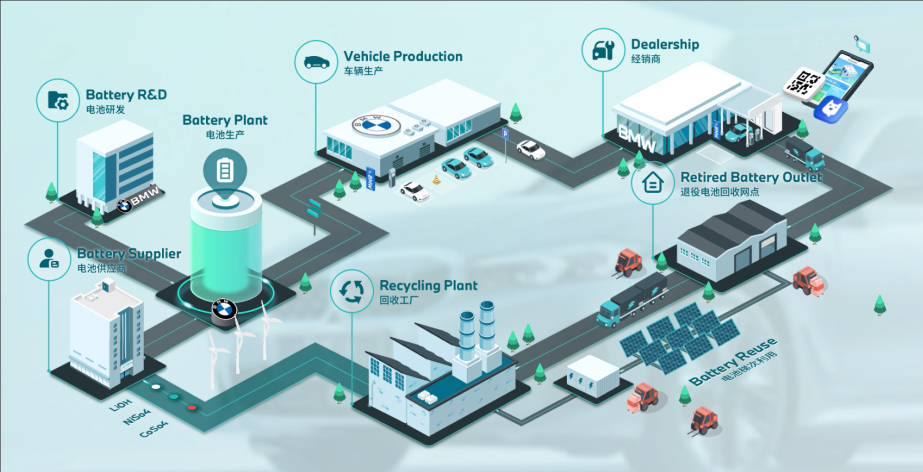
In recent years, the rapid growth of the global new energy vehicle market has made battery recycling and reuse a critical part of advancing sustainability. The BMW Group is at the forefront of innovation in this field, particularly in the recycling and circular use of high-voltage batteries. In 2022, BMW successfully launched a closed-loop recycling system for high-voltage battery raw materials in China, achieving significant results. Now, the BMW Group is deepening its collaboration by establishing a European partnership with SK tes, a technology lifecycle solutions provider, to promote the global deployment of battery recycling technologies.
Innovative Practices of the Closed-Loop Battery Recycling System
The partnership between BMW Group and SK tes marks a new phase in battery recycling. During the recycling process, valuable metals such as cobalt, nickel, and lithium from used high-voltage batteries will be effectively extracted and returned to the battery production value chain. This closed-loop system not only improves the utilization rate of battery raw materials but also significantly reduces negative environmental impacts, providing a new pathway for the sustainable development of the battery industry.
BMW Group has stated that this recycling system will be expanded to North America, including the United States, Mexico, and Canada, as early as 2026. This means that BMW, having achieved success in the Chinese and European markets, plans to replicate this green circular economy model globally, supporting the electrification transition in more regions.
Battery Recycling Process and Technical Advantages
The BMW-SK tes partnership focuses not only on recycling but also on high-tech processes and innovation. The process involves mechanically shredding used batteries and refining the metals into a concentrated black mass. This black mass is then further treated through hydrometallurgical chemical processes to effectively recover metals such as nickel, cobalt, and lithium. The secondary materials recovered through this process can be reused in BMW's new GEN 6 electric drive system, thus achieving the circular use of battery raw materials.
This recycling method effectively improves battery utilization, reduces the demand for raw materials in new battery production, and lessens environmental pressure. SK tes‘s battery recycling technology has received multiple sustainability and innovation awards, further demonstrating its technological leadership and feasibility.
BMW Group’s Circular Economy Strategy
The BMW Group is committed to promoting a circular economy, integrating this concept throughout its entire production chain. From vehicle design and production to recycling and reuse, every step BMW takes lays the foundation for the sustainable circularity of batteries and other materials. Jörg Lederbauer, Vice President Circular Economy for Battery High-Voltage Power and Electric Powertrain at BMW Group, stated: "Through our partnership with SK tes, we have significantly improved efficiency in battery recycling and the circular economy. The experience and technology of all partners complement each other in this process, jointly contributing to the success of closed-loop battery recycling."
BMW’s recycling and dismantling center is a key component of its circular economy strategy. Having operated for over 30 years, the center has made significant progress in parts and material recycling. By continuously optimizing recycling processes, BMW minimizes resource waste, enhances supply chain resilience, and ensures that all recyclable materials can smoothly re-enter new cycles of production and use after the end of a vehicle‘s life.
Sustainable Development for the Future
BMW Group’s circular economy strategy extends beyond battery recycling to encompass the sustainable development of the entire automotive industry. From the initial stages of vehicle design, BMW considers how to minimize resource consumption and improve material recyclability. This strategy helps BMW take significant steps towards achieving its carbon neutrality goals.
Looking ahead, as the electric vehicle market continues to expand, battery recycling and reuse will become even more urgent. Through its partnership with SK tes, BMW is setting an example for the global automotive industry. This collaboration not only brings technological innovation to BMW but also drives the global EV industry towards a greener, more sustainable direction.
In summary, through its advanced battery recycling technologies and circular economy strategy, the BMW Group is actively contributing to the sustainable development of the global electric vehicle industry. As technology advances and global cooperation deepens, BMW will continue to lead the automotive industry towards a greener and more environmentally friendly future.
Source:
recyclingproductnews